

By Gaurav Jainn, Z Premium Oils · Jenson & Jenson Lubricant, Delhi (est. 1975)
Every winter, the same headline returns in Delhi-NCR: AQI crosses 300, then 400, and the Commission for Air Quality Management (CAQM) tightens the Graded Response Action Plan (GRAP). This year CAQM invoked GRAP Stage I across the NCR on 21 October 2026, when Delhi’s AQI stood at 244.
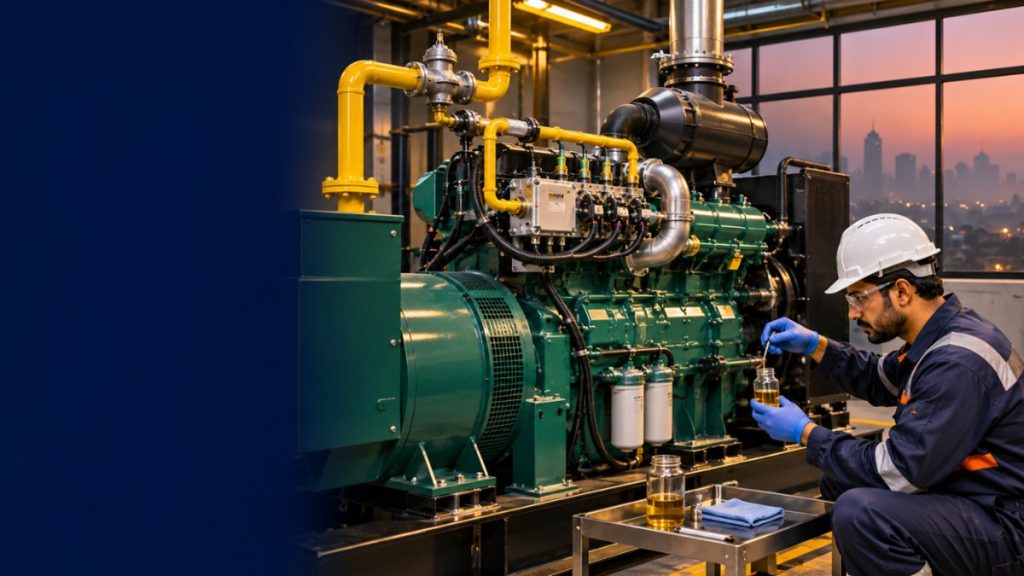
For factories, hospitals, housing societies, malls and data rooms, one rule matters more than any other: what you can and cannot run on a diesel generator. Since 1 October 2023, CAQM requires DG sets across the NCR to be converted to dual-fuel (gas plus diesel) or fitted with approved emission control devices. Owners who did the conversion now face a second, quieter question that almost nobody writes about: what lubricant does a converted genset need?
The DG set rules in plain words
- CAQM’s direction of June 2023 (effective 1 October 2023) covers DG sets in industrial, commercial, residential and office use across the NCR.
- DG sets must run in dual-fuel mode (typically around 70 percent gas and 30 percent diesel) or be fitted with an approved Retrofit Emission Control Device (RECD). Gas can come from piped natural gas or from cylinders and cascades where piped gas is not available.
- Sets that are not converted or retrofitted are not allowed to run in the NCR, and the earlier GRAP exemption for emergency services does not cover them.
- Industry estimates put each conversion or retrofit at roughly Rs 5 lakh to Rs 15 lakh, depending on size.
- Rules are revised from time to time. Always check the latest CAQM directions and your State Pollution Control Board before planning.
Why a converted genset is a different machine for its oil
1. Dual-fuel engines
When natural gas replaces most of the diesel, combustion temperatures and chemistry change. The oil sees less soot but can face more nitration and oxidation, which thicken the oil and form varnish. The engine maker or kit supplier’s oil recommendation, often a quality heavy-duty diesel engine oil such as API CI-4 or CK-4 15W-40, should be followed, and drain intervals confirmed by oil analysis rather than assumed.
2. Retrofit emission control devices (RECD)
An RECD traps particulate matter. Oil that burns in the combustion chamber leaves ash, and ash cannot be burned off; it slowly plugs the filter and raises back-pressure. Lower-ash oils, such as API CK-4 (sulphated ash limited to 1.0 percent), help protect the device, and so does keeping oil consumption low through good maintenance.
3. Stop-start winter duty
Many NCR gensets run only during power cuts. Short, light-load runs never let the engine reach full temperature, so fuel and water collect in the oil. This “wet stacking” leads to sludge and corrosion. Run the set under adequate load during tests, and check oil condition even if the hour meter barely moved.
A winter checklist for genset owners in Delhi-NCR
- Confirm your DG set’s compliance status (dual-fuel kit or approved RECD) and keep the certificates on site.
- Use the oil grade specified by the engine maker or kit supplier. For RECD-fitted sets, ask about low-ash (CK-4 class) oil.
- Take an oil sample every 250 hours or every 3 months. Look at viscosity, oxidation, nitration, soot, fuel dilution and wear metals.
- Change filters with the oil. A clogged filter cancels the value of good oil.
- Check coolant strength before the coldest weeks; use a proper coolant, not plain water.
- Do a monthly load test long enough to bring the engine up to normal temperature.
- Keep a logbook: hours, oil top-ups, oil changes, sample results.
Example: a hospital in Gurugram (illustrative)
A 500 kVA genset converted to dual-fuel ran mostly short weekly tests and occasional outages. After the conversion, maintenance staff kept the old oil-change schedule of a fixed number of months. A simple oil analysis would show whether the oil is thickening from nitration or diluting from fuel. Moving to condition-based changes means the team changes oil when the test says so, avoiding both premature changes (wasted oil and money) and late changes (engine wear in the one week the hospital needs the set most).
Why this is a national story, not just Delhi’s
Gensets keep India’s factories, towers, hospitals and housing societies running. As other cities adopt clean-air action plans, the NCR approach of dual-fuel conversion and emission control is likely to spread. Getting lubrication right is the cheapest way to protect an expensive conversion.
Related reading: 15W-40 engine oil for trucks, tractors and DG sets.
Frequently asked questions
Are diesel generators banned in Delhi-NCR?
Unconverted DG sets are not allowed to run in the NCR. Sets converted to dual-fuel or fitted with an approved emission control device may run, subject to the latest CAQM and SPCB directions.
Which engine oil is best for a dual-fuel genset?
Use the grade specified by the engine maker or kit supplier, usually a heavy-duty diesel engine oil, and set drain intervals using oil analysis.
Does an RECD need special oil?
Low-ash oils such as API CK-4 help protect particulate-trapping devices from ash build-up. Confirm with the device supplier.
How often should genset oil be changed?
Follow the manufacturer’s hours or months, whichever comes first, and confirm with oil analysis, especially for sets that run short, light-load cycles.
Sources
- News On AIR: CAQM invokes Stage I GRAP across NCR (21 Oct 2026)
- The Tribune: Diesel generators banned from Oct 1 unless converted
- Lexplosion: CAQM revised schedule for DG sets in NCR
- CAQM directions archive
Talk to Z PREMIUM Oils
Running dual-fuel or RECD-fitted gensets in Delhi-NCR? Ask us for the right genset oil and a sampling plan.
- Company: Jenson & Jenson Lubricant (brand: Z PREMIUM Oils), Azadpur, Delhi. Est. 1975, ISO 9001:2015, MSME/NSIC registered
- Phone: +91 98116 40318
- Email: zpremiumcorporate@gmail.com
- B2B and bulk supply: jensonlubricant.com
- Retail packs: zpremiumoils.in
Clean power, compliant gensets, zero downtime.
Written by Gaurav Jainn
Gaurav Jainn heads Z Premium Oils, the premium brand of Jenson & Jenson Lubricant, a Delhi manufacturer of automotive, industrial and defence lubricants since 1975. The company is ISO 9001:2015 certified and MSME/NSIC registered, and supplies Indian Railways, NTPC, BHEL and leading OEMs. Gaurav oversees product approvals and technical recommendations for B2B buyers. Ask a lubrication question.