

By Gaurav Jainn, Z Premium Oils · Jenson & Jenson Lubricant, Delhi (est. 1975)
Between December 2025 and January 2026, police in three different states raided three fake engine oil units. In Delhi’s Nangloi they found about 3,950 litres of oil and 12,000 empty bottles and buckets, worth over Rs 1 crore. In Zirakpur, Punjab, used engine oil collected from scrap dealers and service centres was being tinted and packed under well-known two-wheeler oil labels. In Eluru, Andhra Pradesh, a gang was “cleaning” used oil with urea and refilling it into branded tins.
The bottle on the shelf looked genuine in every case. That is the problem. This guide shows how the racket works, what fake oil does to an engine, and 11 checks anyone can do in a shop or a stores department before paying.
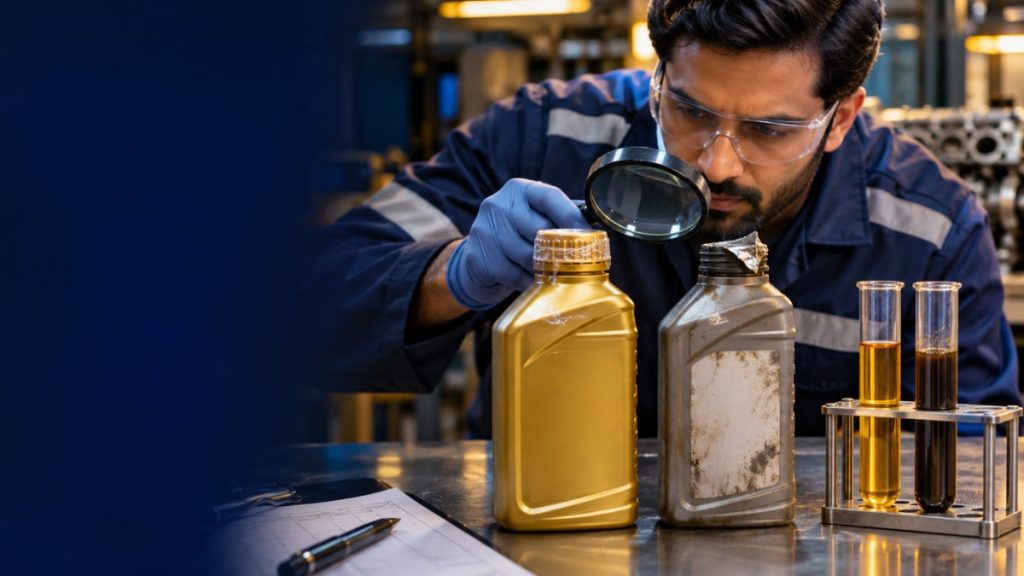
Three busts, one pattern
| Where and when | What police found | How the oil was made |
|---|---|---|
| Nangloi, Delhi (reported 18 Dec 2025) | About 3,950 L of oil, about 12,000 empty bottles and buckets, fake labels, sealing machines. Value over Rs 1 crore | Cheap loose oil filtered, coloured, filled and sealed under counterfeit labels; sold for cash outside Delhi |
| Zirakpur, Punjab (reported 5 Jan 2026) | “Thousands” of containers and fake labels of popular two-wheeler oils | Used engine oil from scrap dealers and service centres, chemically treated and tinted |
| Eluru, Andhra Pradesh (1 Jan 2026) | Processing chemicals, a cap-sealing machine, branded labels, empty tins | Used engine oil “filtered” with urea and refilled into branded containers |
The common thread: used oil goes in, a “new” branded pack comes out. Drained oil that should go to a licensed re-refiner is sold to a kabadi for a few rupees a litre and ends up back in somebody’s engine.
Why fake oil is so dangerous
Engine oil is about 75 to 90 percent base oil plus an additive package: detergents, dispersants, anti-wear compounds (such as ZDDP), antioxidants and viscosity modifiers. Used oil has already burned through most of those additives and is loaded with soot, fuel, water and fine metal. Filtering and colouring hides the dirt but cannot put the chemistry back.
- No anti-wear protection: cam lobes, piston rings and bearings wear quickly, often within a few thousand kilometres.
- Sludge and varnish: without detergents, deposits block oil passages and stick piston rings.
- Wrong viscosity: a “20W-40” label on oil that behaves like SAE 10 or SAE 60 means poor cold starts or oil starvation at high temperature.
- Acids and water: corrode bearings and, in two-wheelers with wet clutches, cause clutch slip.
- Lost warranty: OEMs can refuse claims when the failure is traced to non-genuine oil.
11 checks before you buy
At the counter
- Price check. If a branded oil is 30 to 40 percent below the market rate, ask why. Base oil and additives have a floor price; nobody sells genuine oil at a loss.
- Seal and cap. Look for an intact induction foil under the cap, a tamper-evident ring that breaks on opening, and no glue marks.
- Print quality. Blurred text, spelling mistakes, wrong colours, uneven label edges and labels that peel easily are warning signs.
- Batch number and dates. Genuine packs carry a laser or inkjet batch code, manufacturing date and MRP. Missing or hand-stamped codes are a red flag.
- Legal Metrology details. Indian law requires the manufacturer or packer name and address, net quantity, MRP, month and year of manufacture, and a consumer care contact on every pre-packed retail pack.
- Scratch codes and QR. Many brands print a QR or scratch code. Scan it on the brand’s official site or app, not a link printed on the bottle.
- Weight and fill level. Compare with a pack you know is genuine. Underfilled or heavier-than-normal packs deserve a second look.
In the workshop or stores
- Look at it. Fresh engine oil is clear, amber to golden. Very dark, cloudy or gritty oil from a “new” pack is suspicious.
- Smell it. A burnt or fuel-like smell suggests recycled used oil.
- Blotter spot test. Put a drop on white filter paper or tissue and wait an hour. Genuine new oil leaves a clean, light ring. A dark centre or black specks point to soot and contamination.
- Ask for paperwork. For bulk or B2B purchases, ask for the technical data sheet (TDS), safety data sheet (SDS) and a batch test certificate showing viscosity, viscosity index, flash point and TBN. A genuine manufacturer shares them without hesitation.
A simple rule for purchase managers: no batch certificate, no purchase order. It costs the supplier nothing to share one if the oil is genuine.
A worked example: what a fake 1-litre pack really costs
Illustrative numbers. A delivery rider saves about Rs 150 by buying a cheap “branded” 1-litre bike oil. If that oil wears the engine and causes a piston, ring and valve job, the repair can easily run to Rs 6,000 to Rs 10,000 plus three or four days off the road. For a rider earning Rs 800 to Rs 1,000 a day, the “saving” turns into a loss of more than Rs 10,000. For a fleet of 50 trucks or a factory with 20 hydraulic presses, the multiplier is far larger.
Where the fake oil comes from: your own drain pan
Every litre of used oil sold to an unlicensed scrap buyer is raw material for this racket. Since 1 April 2024, India’s Extended Producer Responsibility (EPR) rules for used oil require producers to ensure collection and re-refining through registered recyclers. Workshops, fleets and factories can help by handing used oil only to CPCB/SPCB-authorised collectors and keeping the receipt. Read our complete guide to EPR for used oil.
What to do if you suspect fake oil
- Stop using it and keep the pack, bill and a sealed sample.
- Report it to the brand’s consumer care number (printed on genuine packs).
- File a complaint on the National Consumer Helpline (1915 or consumerhelpline.gov.in) and with your State Legal Metrology department.
- For large quantities, inform the local police. Counterfeiting a registered trademark is a criminal offence under the Trade Marks Act, 1999.
How Z PREMIUM protects buyers
Z PREMIUM Oils is made by Jenson & Jenson Lubricant, a Delhi manufacturer working since 1975 and certified to ISO 9001:2015. Every batch is tested before dispatch, and we share the TDS, SDS and batch test report on request. Institutional buyers such as Indian Railways, NTPC and BHEL buy against specifications, and the same batch documentation is available to any workshop or factory.
Frequently asked questions
How can I check if engine oil is original?
Check the price, seal, print quality, batch code, Legal Metrology details and QR or scratch code, then do a simple blotter spot test. For bulk purchases, ask for a batch test certificate.
Is fake engine oil made from used oil?
Often, yes. Recent raids in Punjab and Andhra Pradesh found used engine oil being treated, tinted and refilled into branded containers.
What happens if I use fake engine oil?
Faster wear of rings, bearings and cams, sludge, poor cold starts or oil starvation, clutch slip in bikes, and possible loss of warranty.
Where should I dispose of used engine oil?
Only through a collector or re-refiner authorised by the CPCB or your State Pollution Control Board. Keep the receipt.
Sources
- ThePrint / PTI: Delhi Police busts fake engine oil unit in Nangloi
- Rozana Spokesman: Zirakpur fake engine oil racket exposed
- Republic World: Fake engine oil gang busted in Eluru
- Autocar Professional: Honda acts against counterfeit engine oil in West Bengal
Talk to Z PREMIUM Oils
Want genuine, batch-tested oil with documents for every lot? Ask us for the TDS and test certificate of any grade.
- Company: Jenson & Jenson Lubricant (brand: Z PREMIUM Oils), Azadpur, Delhi. Est. 1975, ISO 9001:2015, MSME/NSIC registered
- Phone: +91 98116 40318
- Email: zpremiumcorporate@gmail.com
- B2B and bulk supply: jensonlubricant.com
- Retail packs: zpremiumoils.in
Genuine oil. Genuine protection.
Written by Gaurav Jainn
Gaurav Jainn heads Z Premium Oils, the premium brand of Jenson & Jenson Lubricant, a Delhi manufacturer of automotive, industrial and defence lubricants since 1975. The company is ISO 9001:2015 certified and MSME/NSIC registered, and supplies Indian Railways, NTPC, BHEL and leading OEMs. Gaurav oversees product approvals and technical recommendations for B2B buyers. Ask a lubrication question.