

By Gaurav Jainn, Z Premium Oils · Jenson & Jenson Lubricant, Delhi (est. 1975)
“Electric vehicles don’t need oil” is one of the most repeated lines in Indian auto conversations. It is half true. An EV has no engine oil to change every 5,000 km, but it still runs on several carefully engineered fluids, and using the wrong one can damage a motor or battery far costlier than any engine.
With India selling about 2.27 million electric vehicles in calendar year 2025 (about 1.28 million two-wheelers, 0.8 million three-wheelers and 1.77 lakh cars and SUVs), this is no longer a niche question. Here is what every EV owner, fleet manager and workshop should know.
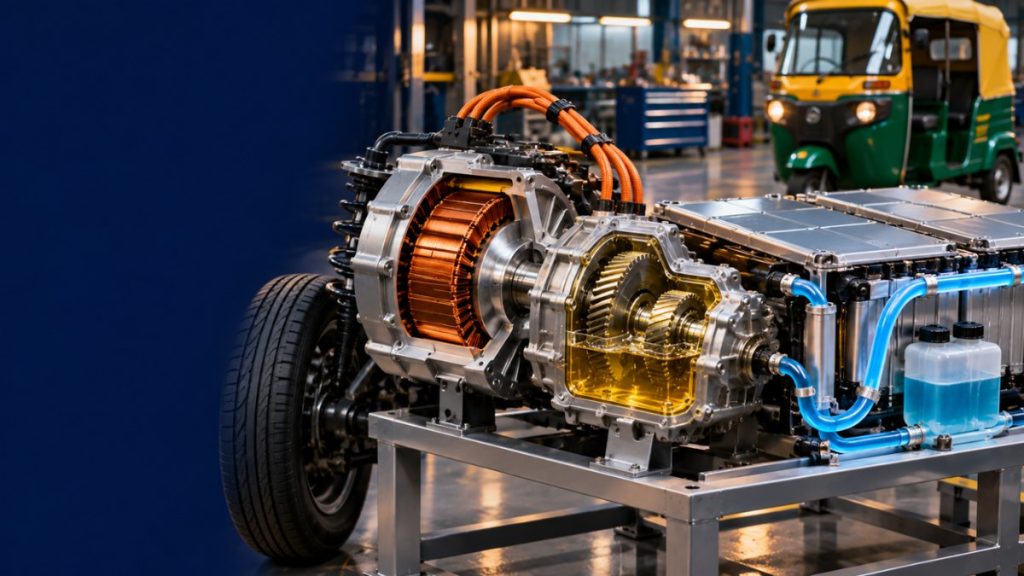
The 6 fluids inside a typical EV
| Fluid | Where it works | Why it matters |
|---|---|---|
| Reduction gear / e-transmission fluid | Single-speed reducer between motor and wheels | Protects gears at very high motor speeds; must also be compatible with copper windings and seals |
| Battery and power-electronics coolant | Battery pack, inverter, on-board charger | Keeps cells in their safe temperature window; low electrical conductivity matters |
| Brake fluid (DOT 3, DOT 4 or as specified) | Hydraulic brakes | Regenerative braking means brakes are used less, so fluid can absorb moisture unnoticed |
| Bearing grease | Motor bearings, wheel bearings | Must handle high speed, low noise and, in some designs, stray electrical currents |
| Thermal management / AC fluid | Heat pump or AC circuit | Shares the cooling system in many EVs |
| Washer fluid and others | Body systems | Same as any vehicle |
Why EV fluids are different from normal oils
- Speed: EV motors can spin at 15,000 rpm or more. Gear fluid has to resist foaming and shearing at speeds a petrol gearbox never sees.
- Electricity: fluids can touch or sit close to copper windings and high-voltage parts. They need good electrical properties and must not corrode copper.
- Heat: fast charging in a 45 degree Celsius Indian summer pushes batteries hard. The coolant’s job is to keep cells cool and even.
- Long fill-for-life claims: many reducers are “filled for life” on paper, but Indian conditions (dust, heat, heavy loads on e-rickshaws and cargo three-wheelers) can shorten that.
India’s real-world EV maintenance gap
E-rickshaws and cargo three-wheelers are India’s EV workhorses, often overloaded and run 10 to 12 hours a day. Many are serviced at roadside workshops that have never been given a fluid schedule. Common problems include gear whine from the wrong or degraded reducer oil, overheated hub motors packed with ordinary grease, and brakes that feel soft because the fluid has never been changed.
Example: a 3-wheeler fleet
Illustrative case. A last-mile fleet of 40 electric cargo three-wheelers in Delhi-NCR noticed rising gearbox noise after about 25,000 km. The reducers had been topped up with whatever gear oil the local mechanic had. Switching to the grade the vehicle maker specified, changing it on a fixed schedule and greasing wheel bearings with a high-quality lithium complex grease are simple steps that reduce noise and premature bearing failures. The lesson: “maintenance-free” does not mean “maintenance-never”.
EV fluid checklist for owners and fleets
- Read the owner’s manual for the exact reducer oil, coolant and brake fluid specification. Do not substitute by guesswork.
- Check coolant level and colour at every service; never top up with plain water.
- Change brake fluid by time (often every 2 years) even if the pads look new.
- For e-rickshaws and cargo 3-wheelers, inspect reducer oil and wheel bearing grease more often than the brochure suggests.
- Keep a log per vehicle. Fluids are cheap; motors and battery packs are not.
What this means for India’s lubricant industry
EVs reduce engine oil demand in two-wheelers and cars over time, but they create demand for new specialised fluids and greases. Global oil companies have already launched EV fluid ranges in India. Meanwhile, trucks, tractors, construction equipment, generators, railways and industry, which use most of India’s lubricants, will rely on conventional oils for many years. For a manufacturer, the future is both.
Where Z PREMIUM fits
Z PREMIUM supplies greases, brake fluids, coolants and gear oils to fleets, OEM workshops and industry across India. Read our guides on DOT 3 vs DOT 4 brake fluid and engine coolant, or contact us for help matching a fluid to your EV fleet’s specification.
Frequently asked questions
Do electric cars need oil changes?
No engine oil changes, but most EVs have reducer or transmission fluid, battery coolant and brake fluid that need checking and, at some point, replacing.
Can I use normal gear oil in an EV?
Only if the vehicle maker approves it. EV reducers often need low-viscosity fluids with copper compatibility and electrical properties that conventional gear oils may not have.
How often should EV brake fluid be changed?
Follow the manual; many makers specify every 2 years, because brake fluid absorbs moisture over time regardless of use.
How many EVs were sold in India in 2025?
About 2.27 million in calendar year 2025, led by two-wheelers and three-wheelers.
Sources
- Autocar Professional: EV sales in India hit record 2.27 million in CY2025
- Autocar Professional: Gulf Oil launches e-fluids in India
- Autocar Professional: TotalEnergies launches EV fluids in India
Talk to Z PREMIUM Oils
Running an EV, e-rickshaw or mixed fleet? Tell us your vehicle models and we will suggest the right greases, brake fluid and coolant.
- Company: Jenson & Jenson Lubricant (brand: Z PREMIUM Oils), Azadpur, Delhi. Est. 1975, ISO 9001:2015, MSME/NSIC registered
- Phone: +91 98116 40318
- Email: zpremiumcorporate@gmail.com
- B2B and bulk supply: jensonlubricant.com
- Retail packs: zpremiumoils.in
Electric or diesel, the right fluid keeps you moving.
Written by Gaurav Jainn
Gaurav Jainn heads Z Premium Oils, the premium brand of Jenson & Jenson Lubricant, a Delhi manufacturer of automotive, industrial and defence lubricants since 1975. The company is ISO 9001:2015 certified and MSME/NSIC registered, and supplies Indian Railways, NTPC, BHEL and leading OEMs. Gaurav oversees product approvals and technical recommendations for B2B buyers. Ask a lubrication question.